
研究カテゴリー: ストレス関連疾患と機能性身体疾患<研究カテゴリー>

  • Stress-Related Diseases and Functional Somatic Syndromes

    Due to changes in social and medical structures, the structure of diseases is also changing. Somatic symptoms persist, but no abnormalities are found in regular medical examinations, and medical approaches are difficult to be effective. Functional somatic diseases are one of the so-called “stress-related diseases”, but the characteristic is that there are problems with function (activity) rather than visible morphological abnormalities. Such diseases are called
    functional somatic syndrome (FSS).

    Functional Somatic Syndrome

    “Functional somatic syndrome refers to several related syndromes that are characterized more by symptoms, suffering, and disability than by disease-specific, demonstrable abnormalities of structure or function.”
    (Barsky, A. J. & Borus, J. F. , Ann Intern Med. 130, 1999)

    For example, you continue to suffer from stomach pain and heartburn, so you get tested at a hospital, but the gastroscopy shows “no abnormalities”. However, the symptoms persist, and although they improve somewhat with medication, they soon return. You are told everywhere you go that there is “no abnormality” or it’s “just in your mind”.

    This is the case where there are no organic abnormalities such as ulcers or gastritis, but there is a problem with the function (activity) of the stomach, causing symptoms similar to those of gastritis. For example, poor movement of the stomach causing a feeling of heaviness, or excessive secretion of gastric acid causing heartburn. This is called “functional dyspepsia”.

    Core Diseases

    Functional somatic syndrome is said to include the following “core diseases”.

    • Functional Dyspepsia
    • Irritable Bowel Syndrome
    • Fibromyalgia
    • Chronic Fatigue Syndrome

    In gastroenterology, cardiology, dermatology, gynecology, and other fields, there are certain proportions of such diseases.
    Of course, the specific symptoms and pathologies differ depending on the field, but there are common points in their characteristics and responses, such as large fluctuations due to stress and anxiety, and certain effects of antidepressants.

    Examples of Functional Somatic Syndrome in Various Fields

    Below are examples of functional somatic syndrome in various fields, as cited in the literature.

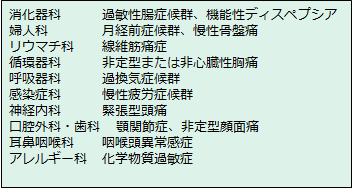
    Functional somatic syndromes by speciality

    • Gastroenterology: Irritable bowel syndrome, functional dyspepsia
    • Gynaecology: Premenstrual syndrome, chronic pelvic pain
    • Rheumatology: Fibromyalgia
    • Cardiology: Atypical or non-cardiac chest pain
    • Respiratory: Hyperventilation syndrome
    • Infectious diseases: Chronic (postviral) fatigue syndrome
    • Neurology:Tension headache
    • Dentistry: Temporomandibular joint dysfunction, atypical facial pain
    • Ear, nose, and throat: Globus syndrome
    • Allergy: Multiple chemical sensitivity
    (Wessely S, Nimnuan C, Sharpe M. Functional somatic syndromes: one or many? Lancet. 1999 Sep 11;354(9182):936-9.)

    Characteristics and Issues of Functional Diseases

    In these diseases, subjective (self-aware) symptoms often do not match objective (medical) assessments, causing various problems. For example, undergoing unnecessary medical examinations, miscommunication with medical personnel, and stress from not being understood by those around you.

    Below are summarized the characteristics and issues.

    • Various secondary problems due to the “gap” between subjective bodily symptoms and disabilities and medical explanations, leading to chronicity and complexity of symptoms, confusion including surrounding systems, and a vicious cycle.
    • A pathological state is formed by the interaction of both physical factors (functional pathology) and psychological/social factors.
    • Although diagnostic names are given in various specialized areas, there are overlaps in symptoms and diagnostic criteria, and symptom migration, combining individual pathologies with common pathologies.
    • In physiological processes, abnormalities in autonomic nervous/thalamo-pituitary system functions, and stress response system functions are involved in the pathology.
    • Anxiety and depression are involved as psychological/social factors, but only partially.
      Other factors such as amplification of bodily sensations, lack of support from family and others, illness behavior, and stigma are involved.

    Given such characteristics and issues, more appropriate understanding and responses to the pathology are required.
    Therefore, we are examining psychosomatic evaluation and therapeutic methods for functional somatic syndrome and stress-related diseases from various angles.

  • ストレス 関連疾患と機能性身体疾患

    近年、社会や医療構造の変化などに伴って、疾患の構造も変化しつつあります。
    身体症状が続くのに、通常の医学的検査で対応した異常がみつからず、医学的アプローチが奏功しにくい疾患が増えてきました。機能性身体疾患は「 ストレス 関連疾患」 と呼ばれるものの一つですが、目に見える形態の異常よりも、機能(はたらき)に問題があるのが特徴です。

    機能性身体症候群 Functional Somatic Syndrome

    欧米諸国でも同様の問題があり、それらの疾患は
    機能性身体症候群(functional somatic syndrome; FSS)
    と呼ばれています。

    「身体症状の訴え、苦痛、障害の程度が、個々の疾患に特異的な構造や機能によって説明できる障害の程度に比べて大きいという特徴を持つ一連の疾患群」と定義されています。

    例えば、胃痛や胸焼けが続くので病院で検査をしたけど、胃カメラでは「異常がない」。しかし、症状は続き、薬で多少はよくなるものの、またすぐに症状がでてくる。どこへ行っても「異常がない」「気の問題だ」などと言われる。

    このようなケースは、潰瘍や胃炎など、器質的な異常はないのですが、胃の機能(はたらき)に問題があり、胃炎などと同じ症状が出ます。たとえば、胃の動きが悪くて胃のもたれ感が続いたり、胃酸が過剰に分泌されて胸やけが生じたりします。これは、「機能性ディスペプシア」とよばれているものです。

    代表的疾患(コア疾患)

    機能性身体症候群には、次のような代表的な疾患(コア疾患と呼ばれます)があるとされています。

    • 機能性ディスペプシア
    • 過敏性腸症候群
    • 線維筋痛症
    • 慢性疲労症候群

    消化器内科、循環器内科、皮膚科、婦人科など、いずれの領域でも、一定の割合でこのような疾患があります。
    領域によって具体的な症状や病態は当然異なるのですが、ストレスや不安などによる変動が大きい、抗うつ剤が一定の効果をもたらすなど、その特徴や対応に一定の共通点があります。

    各領域における機能性身体症候群の例

    以下に、各領域における機能性身体症候群の例について、文献で挙げられているものを示します。

    (Wessely, S. et al., Lancet, 354, 1999 を翻訳)
    機能性疾患の特徴と問題点

    これらの疾患では、主観的(自覚的)な症状と客観的(医学的)評価が一致しないことが多く、さまざまな問題を生じます。たとえば、無用な医学的検査を受ける、医療者側とすれ違いが生じる、周囲に理解してもらえないストレスが生じるなどです。

    以下にその特徴と問題点をまとめます。

    • 主観的な身体症状や障害の体験と、医学的説明の間の「ずれ」によるさまざまな二次的問題が、症状の慢性化、複雑化、周囲のシステムを含めた混乱などを招き、悪循環に陥る。
    • 身体的要素(機能的病態)と心理・社会的要素の両者が関与しあった病態を形成する。
    • 各専門領域で診断名がつけられるが、症状や診断基準の重複、症状移動がみられ、個別の病態と共通の病態を併せ持つ。
    • 生理的プロセスでは、自律神経・視床下部下垂体系機能異常、ストレス反応系の機能異常が病態に関与するとされる。
    • 心理社会的因子として不安・抑うつの関与があるが、部分的な関与である。
      その他、身体感覚の増幅、家族など周囲のサポートの欠如、疾病行動、烙印 (stigma)などが関与する。

    このような特徴や問題を踏まえ、より適切な病態把握と対応が求められています。
    そこで機能性身体症候群やストレス関連疾患における心身医学的な評価と対応方法の検討を、色々な角度から行っています。

    関連Blog (English)